
Radio ArraY (RAY) at IIT Kanpur
Measuring radio emissions at meterwavelengths & microwaves

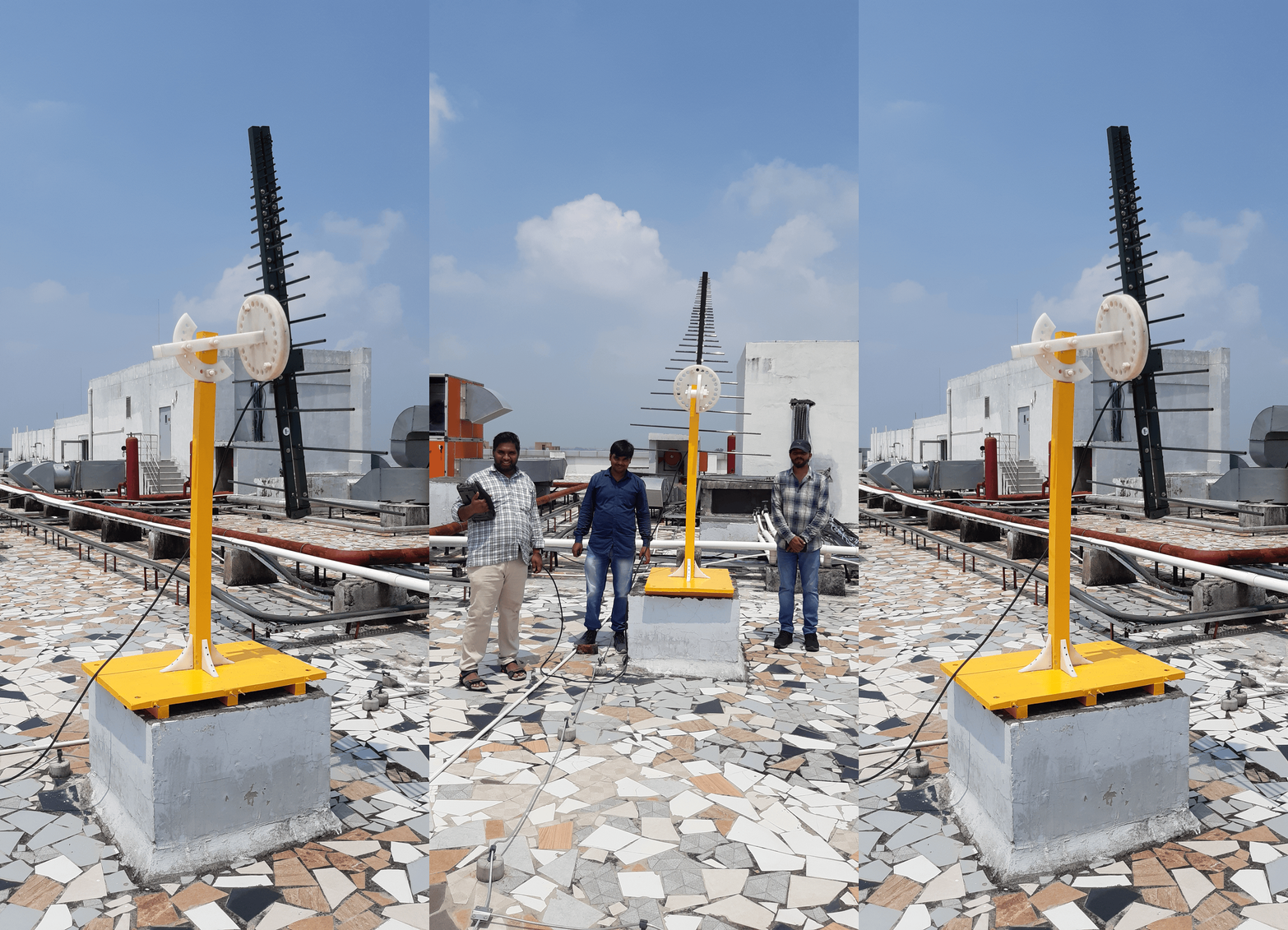
One of the log-periodic antennas deployed at the rooftop of ESB-2 at IIT Kanpur. The flexible mount allows measurements to both high and low declinations.
RAY (Radio ArraY) is a scalable 6-element radio interferometer array designed to operate across the frequency range of 200–2000 MHz. The system comprises high-performance antennas, a wideband receiver chain, a digital correlator backend, and a robust data acquisition infrastructure, with the flexibility to expand into a larger array configuration as research needs evolve. The array is intended for rooftop deployment at IIT Kanpur, incorporating appropriate ground shielding to minimize radio frequency interference and ensure optimal performance in an urban environment. It achieves an instantaneous bandwidth of at least 300 MHz, enabling high-resolution spectral and temporal observations.
RAY’s wide bandwidth, high frequency, and high time resolution, along with its imaging and full polarization capabilities,
make it invaluable for
1. telecommunications to detect and pinpoint sources of interference. For aerospace, it can track fast-moving objects,
while for the space industry, it can locate and predict space debris.
2. The radio array's radar mode makes it highly suited for surveillance and defence applications, including security testing.
Rooftop ESB-2, SPASE, Indian Institute of Technology Kanpur
Kalyanpur, Kanpur, Uttar Pradesh 208016, India
Experiments conducted in September and October 2025 to characterize RFI at 200 MHz and 2 GHz using a log-periodic antenna and oscilloscope.
Strong persistent emissions were observed across the band, particularly in GSM frequencies.
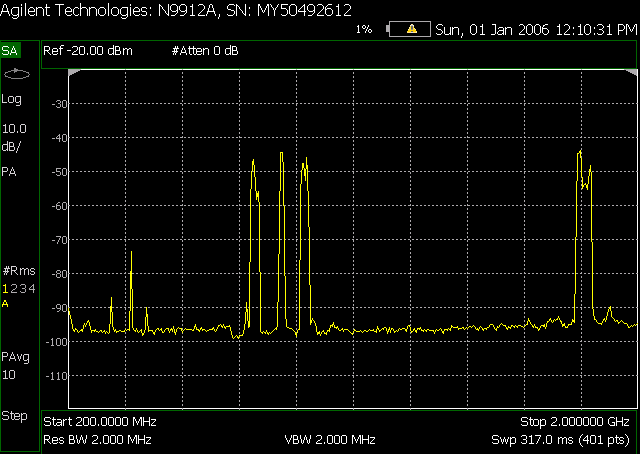
Typical RFI Spectrum on the rooftop ESB-2
Note intermittent emission in low frequency (left). Likely communication-related.
Click to navigate through the timeline
Detection of wideband transient emissions
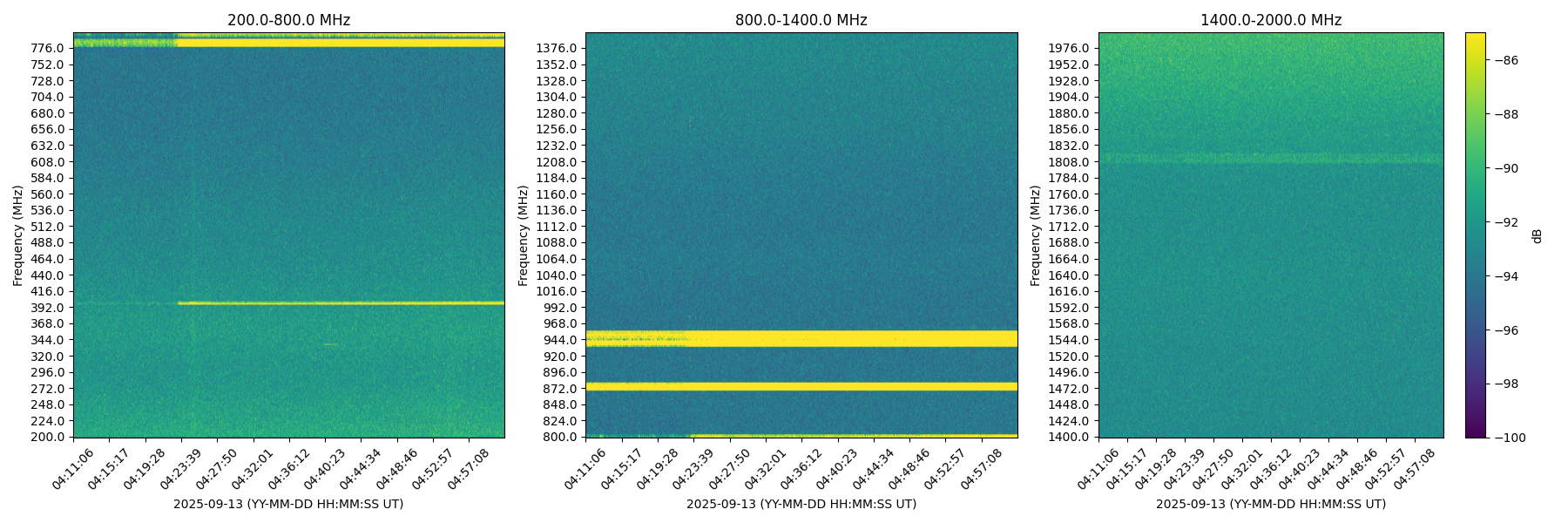
FM station switch ~04:22 IST
Faint vertical stripe (likely lightning) after ~04:22:39 IST
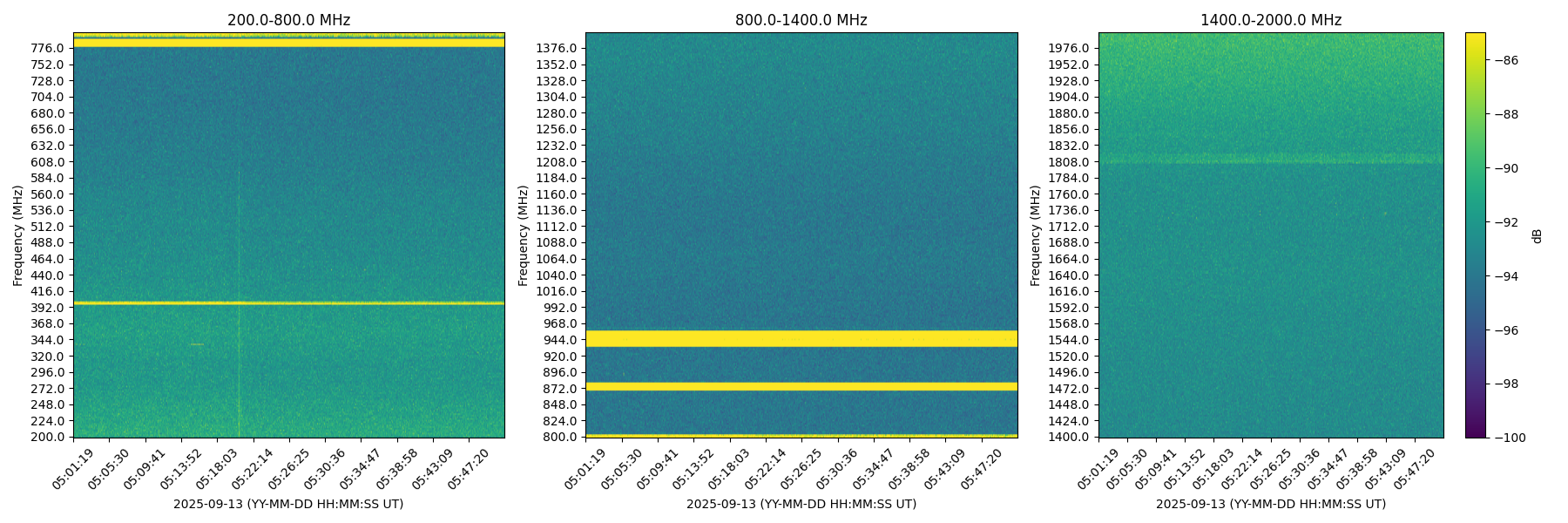
Faint vertical stripe (likely lightning) ~05:18:03 IST
We are establishing a state-of-the-art radio array at IIT Kanpur, designed to advance both space sciences and industrial applications. This wideband instrument features imaging capabilities, high-frequency resolution (up to 100 kHz and 10 ms time resolution), and full polarization, enabling groundbreaking research in solar and space physics while providing a unique testing facility for industry.
Key technical specifications of the proposed radio array include:
Dr. Rohit Sharma
Department of Space, Planetary & Astronomical Sciences & Engineering (SPASE)
Indian Institute of Technology Kanpur
Kanpur, Uttar Pradesh - 208016, India
Email: rsharma@iitk.ac.in
For collaboration, data requests or inquiries